

How Are The Shapes Alike
Chapter 9: Similar shapes
In this chapter, nosotros volition explore the mathematical meaning of the term "similar shapes". The full general meaning of the discussion "similar" is that ii or more things are near the same. In Mathematics, similarity has a very specific meaning.
In Mathematics, two shapes are similar simply if:
- their matching sides are in proportion, and
- their matching angles are equal.
In other words, if two objects are similar to each other, one of them can be "zoomed in" or "zoomed out" to brand information technology identical to the other one.
similar Two shapes are similar merely if their matching sides are in proportion, and their matching angles are equal.
9.1 Similar shapes around us
If y'all compare two dissimilar shapes in your environment, you lot will notice that some of the shapes are similar, and some of the shapes are non similar.
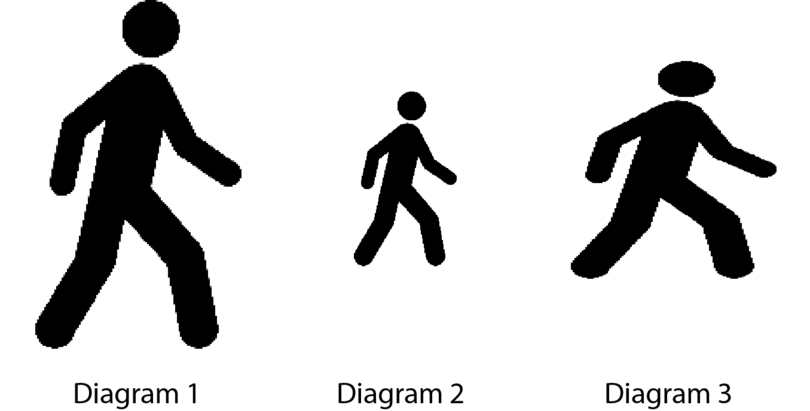
The ii figures in Diagram ane and Diagram two are similar, considering the figure has stayed in proportion in these two diagrams. The first effigy is twice equally alpine and twice every bit wide every bit the second effigy.
The figure in Diagram 3 is non similar to the figures in the other two diagrams, because the proportions are different. The relationships between the length and latitude of the third figure and the other ii figures are unlike.
in proportion Two shapes are in proportion if all their dimensions are in the same ratio. For case, the length and latitude of B are iii times the length and breadth of A, so A and B are in proportion.
ratio A ratio states what the relationship betwixt two quantities or shapes is. For example, the ratio of A's length to B'south length is . We can besides write ratio every bit a fraction, for case .
Practice 9.1: Recognise similar shapes
-
Three diagrams of windows are given.
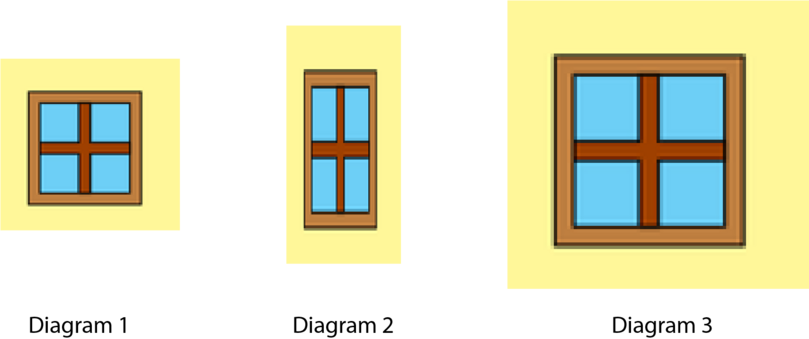
Write downwardly the numbers of the two diagrams that show similar windows.
The windows in Diagram 1 and Diagram 3 are similar.
-
Three diagrams of a shoe are given.
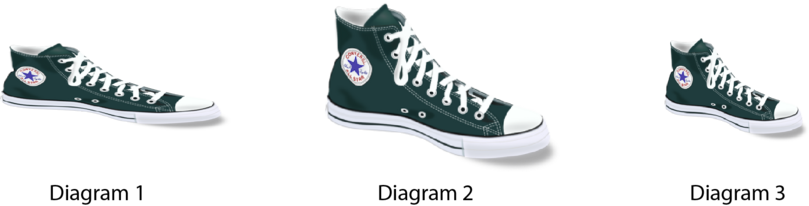
Write downwards the numbers of the two diagrams that show similar shoes.
The shoes in Diagram two and Diagram 3 are like.
-
The diagram below shows three pentagons.
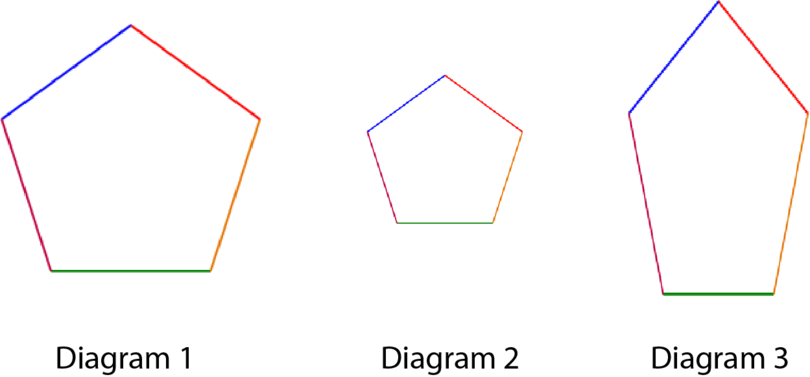
Write down the numbers of the ii diagrams that show like pentagons.
The pentagons in Diagram one and Diagram 2 are similar.
-
The photo below shows cubes and plastic balls. Consider the photo and answer the questions that follow.
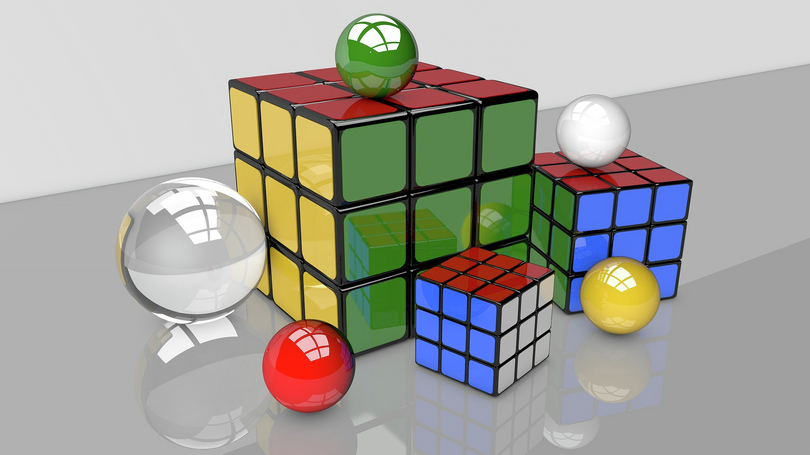
- True or fake: The cubes are similar to each other.
Truthful
- True or fake: The plastic balls are non similar to each other.
False. The plastic assurance are similar to each other.
-
Explain why the pencils in the photo below are non similar.

The pencils are not similar because all the pencils have the aforementioned thickness, but they are of different lengths.
For similar pencils, the shorter pencils would have to exist thinner than the longer pencils.
Similar shapes in Mathematics
We say that two shapes are similar if they are exactly the same shape, just 1 is bigger or smaller than the other one.
As nosotros have seen, in Mathematics, two shapes are similar merely if:
- their matching sides are in proportion, and
- their matching angles are equal.
In many polygons, we have to show that the matching sides are in proportion and the matching angles are equal, if we want to be certain that the shapes are similar. Only, in triangles, nosotros simply need to prove that one of them is true. This is a special property of triangles, which y'all will larn more about afterward in your school career.
Study the following 3 diagrams to larn more than about what is meant when we say that two shapes are similar.
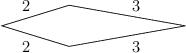
- The ii kites shown beneath are non like, considering:
- their matching angles are equal, but
- their matching sides are not in proportion.
| Kite | Kite |
|---|---|
 |  |
- The two kites shown beneath are not similar, because:
- their matching sides are in proportion, simply
- their matching angles are non equal.
| Kite | Kite |
|---|---|
 |  |
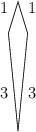
- The two kites shown below are similar, because:
- their matching angles are equal, and
- their matching sides are in proportion.
| Kite | Kite |
|---|---|
 | |
Exercise ix.2: Recognise similar shapes
-
In the photo beneath, a tiled wall is shown.
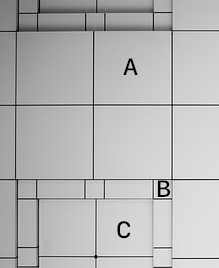
Are the three tiles marked A, B and C similar? Give a reason for your answer.
Yes, tiles A, B and C are similar. They are all squares, and all squares are similar to each other because their matching angles are the same, and their matching sides are in proportion. Each square has four equal sides.
-
In the diagram below, two quadrilaterals are given.
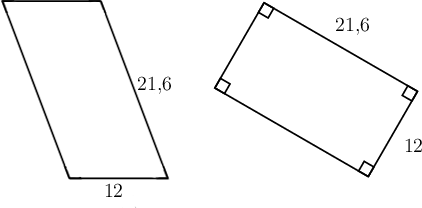
Why are the two quadrilaterals not similar?
The matching angles of the two quadrilaterals are non the same.
-
The diagram below shows two triangles.

Are the two triangles similar? Give a reason for your answer.
The 2 triangles are similar:
- their matching angles are equal, and
- their sides are in proportion, because the measurements of the second triangle are three times bigger than the outset triangle.
-
In the diagram below are 2 cuboids.
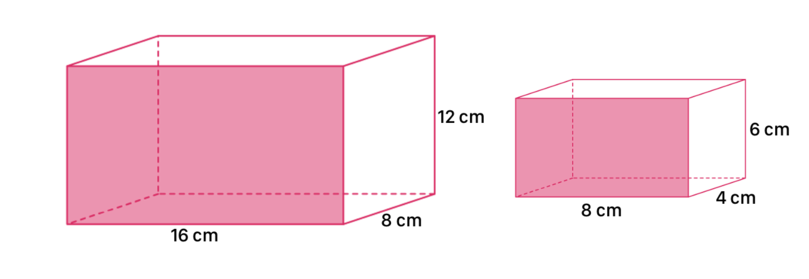
Are the two cuboids similar? Requite a reason for your answer.
The two cuboids are similar:
- the matching angles are equal, and
- the sides are in proportion, because the lengths of the second cuboid are all half the lengths of the first cuboid.
-
In the diagram below, ii 3D objects are given.
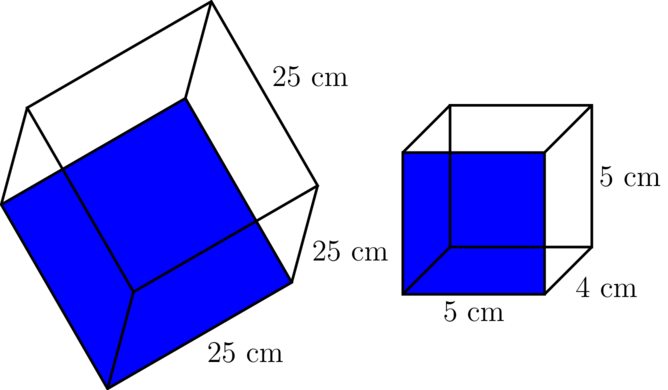
Ekene says: "The two cubes in the diagram are similar, because all cubes are like."
Do y'all agree with Ekene?
All cubes are similar, simply only ane of the objects in the diagram is a cube. The object with sides of 5 cm, 4 cm and 5 cm is not a cube.
Ekene's argument is wrong.
9.two Scale factors
The 2 kites drawn below are like, because:
- their matching angles are equal, and
- their matching sides are in proportion.
| Kite | Kite |
|---|---|
 |  |
The sides of the two kites are in proportion. That means that the lengths of all the sides of one kite have been multiplied by the same number to get the lengths of the sides of the second kite.
If Kite is the given shape, all of the sides in kite have been multiplied by 2 to get the sides of Kite .
Kite is the new shape.
Nosotros can write the lengths of the sides as fractions. Write the measurements of the new shape above the line and the measurements of the given shape below the line.
- The lengths of the longer sides as a fraction:
\begin{marshal} \dfrac{\text{longer side kite } B}{\text{longer side kite } A} & = \dfrac{10}{v} \\ & = 2 \\ \end{align}
- The lengths of the shorter sides equally a fraction:
\begin{align} \dfrac{\text{shorter side kite } B}{\text{shorter side kite } A} & = \dfrac{4}{2} \\ & = two \\ \terminate{align}
In each instance the answer is 2 .
Kite is 2 times bigger than kite .
We say that kite is an enlargement of kite with a scale factor of 2.
We often use the variable to represent the scale gene, so in this case, .
When nosotros write the lengths of sides as fractions, nosotros always write the length of the new shape equally the numerator (above the line) and the length of the given shape as the denominator (below the line).
enlargement An enlargement of a diagram, shape or object is a copy of the original in which everything is made larger, just keeping the same proportions.
scale factor The calibration factor is the number by which every dimension of the given shape is multiplied to get the dimensions of the enlargement. We frequently apply the variable to represent the scale cistron.
Worked example ix.one: Finding the scale factor
The diagram below shows two like triangles:
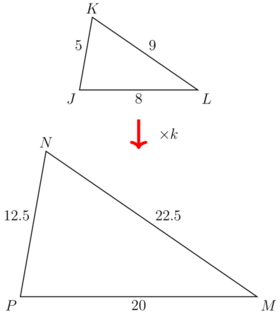
Calculate the scale gene, .
-
Step 1: Check that the two shapes are similar by finding the ratio of all the side lengths. Start by dividing the longest side in the new (bigger) triangle past the longest side in the given (smaller) triangle.
\begin{marshal} \frac{MN}{KL} & = \frac{22.v}{9} \\ &= \frac{22.five \times 10}{nine \times 10} \\ &= \frac{225}{xc} \\ & = 2.5\\ \end{align} -
Step 2: Divide the shortest side in the new (bigger) triangle by the shortest side in the given (smaller) triangle.
\brainstorm{align} \frac{PN}{JK} & = \frac{12.v}{5} \\ &= \frac{125}{50} \\ & = ii.5\\ \terminate{align} -
Step 3: Divide the third side in the new (bigger) triangle by the tertiary side in the given (smaller) triangle.
\brainstorm{marshal} \frac{PM}{JL} &= \frac{20}{8} \\ &= 2.v \\ \end{marshal} -
Step 4: Make a decision.
The shapes are similar because comparison all the side lengths gives the same answer, which is two.5.
This means that the new shape ( ) is 2.v times bigger than the given shape ( ).
-
Step five: Give the answer.
Remember that to carve up by a decimal number, y'all need to multiply both the numerator and the denominator by the same power of x so that you lot tin can dissever past a whole number.
For instance:
\begin{align} \frac{20}{0.four} &= \frac{20 \times 10}{0.4 \times x} \\ &= \frac{200}{4} \\ &= fifty \\ \end{align}
Exercise 9.3: Discover the scale factor
-
The diagram below shows ii similar squares. The figures are drawn to calibration. Find the value of , the calibration cistron.
Shape Shape 
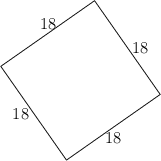
\begin{align} \frac{\text{side of new square}}{\text{side of given square}} &= \frac{18}{ix} \\ & = ii \\ \finish{marshal}
-
Two similar triangles are given. is an enlargement of .
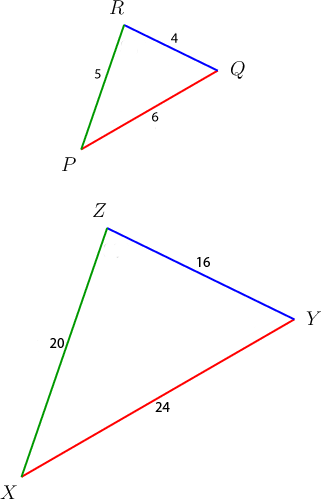
Find the value of the scale factor, .
Ratio of longest sides:
\begin{align} \frac{XY}{PQ} &= \frac{24}{six} \\ & = 4 \\ \end{marshal}Ratio of shortest sides:
\begin{align} \frac{ZY}{RQ} &= \frac{16}{four} \\ & = 4 \\ \finish{marshal}Ratio of third sides:
\begin{align} \frac{XZ}{PR} &= \frac{20}{5} \\ & = 4 \\ \stop{align}All the fractions give 4 as the answer, and then the shapes are similar, and the scale factor is 4.
-
In the diagrams beneath, rectangle is an enlargement of rectangle .
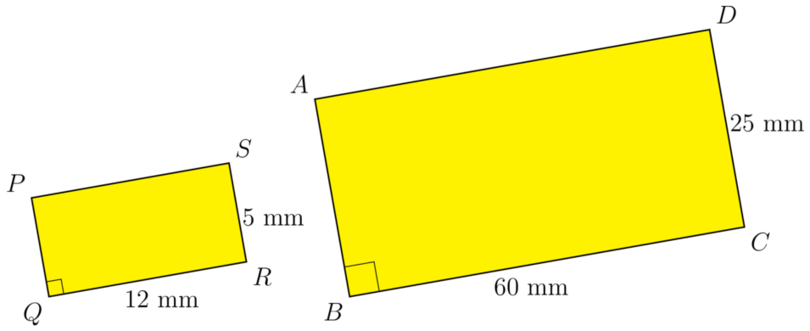
Find the value of the scale factor, .
Ratio of longer sides:
\begin{marshal} \frac{BC}{QR} &= \frac{60}{12} \\ & = 5 \\ \stop{marshal}Ratio of shorter sides:
\begin{align} \frac{DC}{SR} &= \frac{25}{5} \\ & = v \\ \terminate{align} -
The diagrams below show quadrilateral , which is an enlargement of quadrilateral .

Detect the value of the scale factor, .
Ratio of longest sides:
\begin{align} \frac{LM}{KN} &= \frac{15}{5} \\ & = 3 \\ \end{align}Ratio of second longest sides:
\begin{marshal} \frac{QL}{JK} &= \frac{10.five}{3.5} \\ &=\frac{10.v \times 10}{three.5 \times x}\\ &= \frac{105}{35} \\ & = iii \\ \end{marshal}Ratio of shortest sides:
\brainstorm{align} \frac{PM}{RN} &= \frac{half dozen}{two} \\ & = 3 \\ \end{align}Ratio of second shortest sides:
\begin{align} \frac{PQ}{JR} &= \frac{ix}{3} \\ & = 3 \\ \end{align} - 2 cubes are given. Consider the data and answer the questions that follow.
- Cube has sides each of length 7 cm.
- Cube has sides each of length seventy cm.
- True or false: Cube is an enlargement of cube .
The statement is simulated. Cube is an enlargement of cube .
- Summate the value of the scale cistron, .
\begin{align} \frac{\text{side cube } T}{\text{side cube } South} &= \frac{seventy}{vii} \\ & = 10 \\ \finish{align}
-
Cuboid is an enlargement of cuboid .
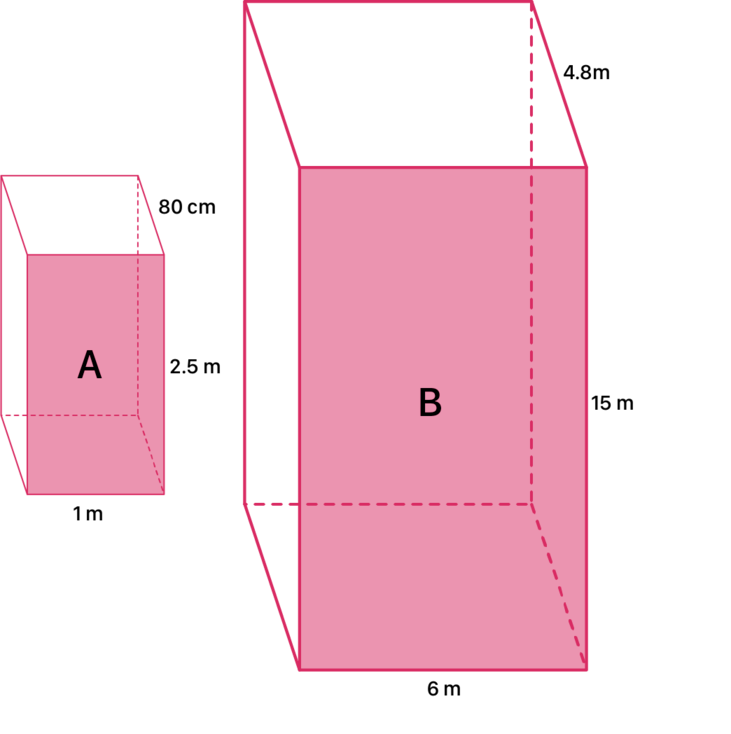
Find the value of the scale factor, .
Ratio of lengths:
Ratio of breadths:
\begin{align} \frac {\text{4.8 g}} {\text{lxxx cm}} &= \frac {\text{480 cm}} {\text{lxxx cm} }\\ & = \frac{480}{eighty} \\ & = 6 \\ \cease{align}Ratio of heights:
\begin{marshal} \frac{15}{ii.5} & = \frac{15 \times 10}{2.5 \times ten} \\ & = \frac{150}{25} \\ & = 6 \\ \end{align} -
Umar says is non an enlargement of .

Do you concord with Umar or not? Give a reason for your answer.
Ratio of longer sides:
\begin{marshal} \frac{DE}{AC} & = \frac{16}{iii} \\ & =5 \frac{1}{three} \\ \end{align}Ratio of shorter sides:
\begin{align} \frac{DF}{CB} & = \frac{12}{3} \\ & = 4 \\ \end{align}The ii ratios are not the same, so is not an enlargement of . Umar's statement is correct.
-
The diagram below shows two triangles. is the given shape and is the new shape.
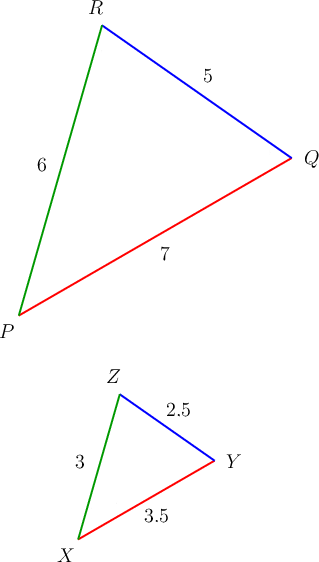
Find the value of , the scale factor.
Ratio of longest sides:
\begin{align} \frac{XY}{PQ} &= \frac{three.5}{seven} \\ &= \frac{3.five \times x}{seven \times 10} \\ &= \frac{35}{lxx} \\ & = \frac{i} {two} \\ \stop{align}Ratio of shortest sides:
\begin{marshal} \frac{ZY}{RQ} &= \frac{ii.5}{5} \\ &= \frac{2.5 \times 10}{5 \times 10} \\ &= \frac{25}{fifty} \\ & = \frac{1}{2} \\ \stop{marshal}Ratio of third sides:
\begin{marshal} \frac{XZ}{PR} &= \frac{3}{6} \\ & = \frac{i}{ii} \\ \end{marshal}
An enlargement where the scale factor is a fraction between 0 and 1 leads to a new shape or object that is smaller than the given shape or object.
Enlarging figures using calibration factors
Y'all know now that an enlargement is a larger version (or a smaller version) of an original length, shape or object. To ensure that the enlargement has the same proportions, we multiply each dimension past the same scale factor, represented past .
If you are given the scale factor, you lot can summate the dimensions of an enlargement of a given shape or object. To practise this, you will apply the equation given above in this form:
Worked example 9.2: Using a calibration cistron
Rectangle is an enlargement of rectangle .
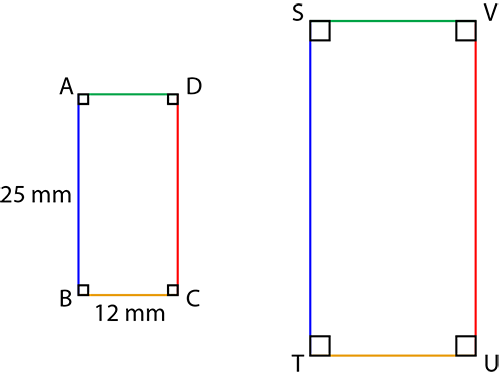
Summate the length and the latitude of rectangle if the scale factor is 3.
-
Step 1: Write down the dominion to calculate the new length.
-
Step 2: Substitute the given values.
\begin{marshal} \text{length of new shape} & = grand \times \text{length of given shape}\\ & = 3 \times \text{25 mm} \\ \cease{align} -
Step 3: Calculate the new length.
\begin{align} \text{length of new shape} & = chiliad \times \text{length of given shape}\\ & = 3 \times \text{25 mm} \\ & = \text{75 mm}\\ \finish{align} -
Step 4: Write down the rule to calculate the new breadth.
-
Pace 5: Substitute the given values.
\begin{align} \text{breadth of new shape} & = k \times \text{latitude of given shape}\\ & = 3 \times \text{12 mm} \\ \end{align} -
Step vi: Summate the new latitude.
\brainstorm{align} \text{breadth of new shape} & = k \times \text{breadth of given shape}\\ & = 3 \times \text{12 mm} \\ & = \text{36 mm}\\ \stop{marshal} -
Footstep vii: Give your reply.
If the calibration gene is 3, the length of rectangle is 75 mm and the breadth is 36 mm.
Do 9.four: Utilize the scale factor
-
Squares and are given. Square is an enlargement of square .
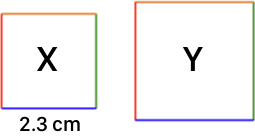
Find the measurements of square if the calibration gene is vii.
\begin{align} \text{side of new foursquare} & = k \times \text{side of given foursquare}\\ & = seven \times \text{2.3 cm} \\ & = \text{sixteen.1 cm}\\ \cease{align}
Foursquare has sides of 16.1 cm.
-
is an enlargement of . Both triangles are right-angled triangles and .
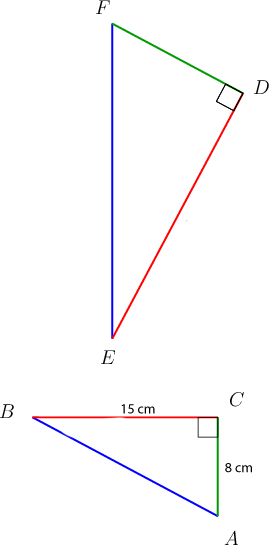
Summate the lengths of , , , and .
You volition need to use the theorem of Pythagoras, which states that in a right-angled triangle,
Use the theorem of Pythagoras to calculate the length of :
\begin{marshal} AB^{2} & = BC^{2} + AC^{two} \quad \text{(Pythagoras)} \\ & = xv^{2} + 8^{2} \\ & = 225 + 64 \\ & = 289 \\ \therefore AB & = \sqrt{289} \\ & = \text{17 cm} \\ \end{align}Use the scale factor to calculate the length of :
\begin{align} EF & = k \times AB\\ & = 2 \times \text{17 cm} \\ & = \text{34 cm}\\ \finish{marshal}Apply the calibration factor to calculate the length of :
\begin{align} DE & = g \times BC\\ & = 2 \times \text{15 cm} \\ & = \text{thirty cm}\\ \terminate{marshal}Use the calibration factor to calculate the length of :
\begin{marshal} DF & = k \times Air conditioning\\ & = 2 \times \text{viii cm} \\ & = \text{xvi cm}\\ \finish{align}The measurements for the new are shown in the diagram beneath.
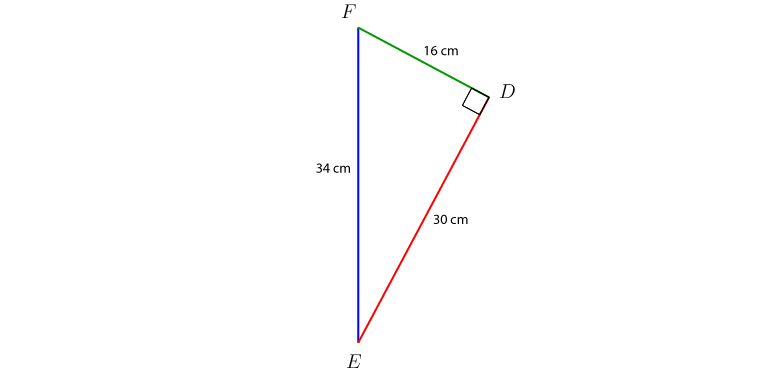
-
In the diagram beneath, parallelogram is an enlargement of parallelogram .

Calculate the dimensions of parallelogram if information technology is given that .
Use scale factor to summate the length of the longer sides:
\begin{marshal} Hard disk& = k \times FE\\ & = nine \times \text{42 mm} \\ & = \text{378 mm}\\ \cease{marshal}Utilise scale factor to calculate the length of the shorter sides:
\brainstorm{align} CD & = k \times Be\\ & = 9 \times \text{31 mm} \\ & = \text{279 mm}\\ \end{align}The dimensions of parallelogram are length 378 mm and latitude 279 mm.
-
The cube shown beneath has sides of 8.5 cm.
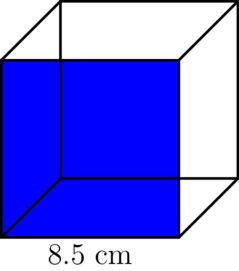
Calculate the length of one side of the cube if the cube is enlarged by a calibration factor of 4.
\begin{align} \text{new side} & = chiliad \times \text{given side}\\ & = four \times \text{eight.five cm} \\ & = \text{34 cm}\\ \end{align}
- A cuboid with the post-obit dimensions are given:
- length = 40 cm
- breadth = 20 cm
- top = 35 cm
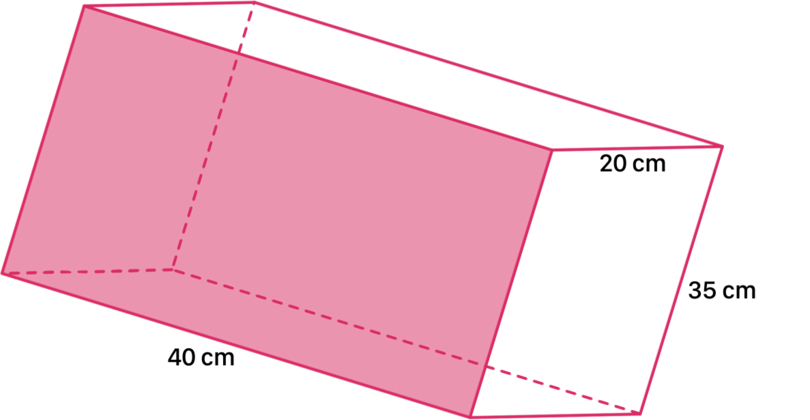
Calculate the dimensions of the new cuboid that is an enlargement of the given cuboid. Utilize a scale cistron of 1.5.
Length:
\brainstorm{align} \text{new length} & = grand \times \text{given length}\\ & = one.5 \times \text{40 cm} \\ & = \text{60 cm}\\ \stop{marshal}Breadth:
\begin{align} \text{new breadth} & = m \times \text{given breadth}\\ & = 1.v \times \text{20 cm} \\ & = \text{30 cm}\\ \end{align}Height:
\begin{align} \text{new tiptop} & = k \times \text{given height}\\ & = 1.5 \times \text{35 cm} \\ & = \text{52.five cm}\\ \end{align}The dimensions of the new cuboid are cm.
-
Polygon is an enlargement of polygon . Consider the two polygons and answer the questions that follow.
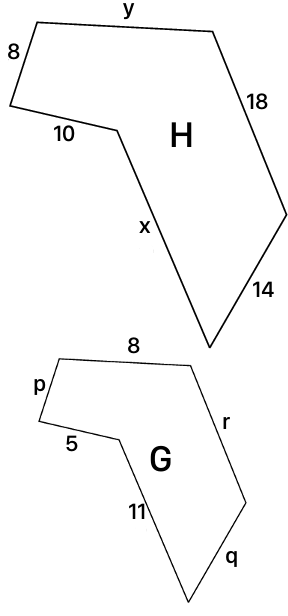
- What is the scale cistron ( )?
There is only ane pair of matching sides where both measurements are given, namely 5 units and ten units.
\brainstorm{align} k & = \frac{\text{length of side shape } H} {\text{length of side shape } Grand} \\ & = \frac{10}{five}\\ & = 2 \end{align}- Write downwardly, using the scale cistron, the values of , , , and .
The measurements in polygon are double the measurements in polygon . The measurements in polygon are half the measurements in polygon .
= = 22 units
= = 16 units
= = 4 units
= = vii units
= 18 = nine units
Using scale factors to calculate area and volume
You lot accept already seen that you tin employ a calibration factor to find different lengths in two similar shapes.
You will now investigate what will happen if y'all calculate the areas and volumes of shapes and objects that are enlarged.
Worked example 9.three: Working with scale cistron and area
2 like correct-angled triangles are given. is an enlargement of .
The scale factor is 2.

Calculate the areas of the two triangles and compare the answers.
Use the value of in your comparison.
-
Step one: Summate the expanse of the given triangle ( ).
\begin{align} \text{Expanse } \triangle BAC & = \frac{i}{2} \times b \times h\\ &= \frac{ane}{ii} \times 16 \times 12\\ &= \text{96 cm}^{2} \\ \end{align} -
Pace 2: Calculate the area of the new triangle ( ).
\brainstorm{align} \text{Area } \triangle DEF& = \frac{1}{2} \times b \times h\\ &= \frac{1}{2} \times 32 \times 24\\ &= \text{384 cm}^{2} \\ \end{align} -
Step 3: Compare the two answers.
Or: =
We can write:
\begin{align} \text{Area of new triangle} & = iv \times \text{area of given triangle} \\ & = 2^2 \times \text{area of given triangle} \\ \terminate{align}
This worked case shows an important relationship. If a shape is enlarged by a scale factor , then the expanse of the new shape will be times greater than the area of the given shape.
When we calculate surface area, we use two dimensions to determine the surface area of a shape (length breadth, or side side, for example). If the scale cistron is , then each one of these two dimensions must be multiplied by to notice the dimensions for the new shape.
Area of the new shape = expanse of given shape
Worked example nine.4: Working with calibration cistron and volume
Two cuboids are given. Cuboid is an enlargement of cuboid . The calibration factor is 2.
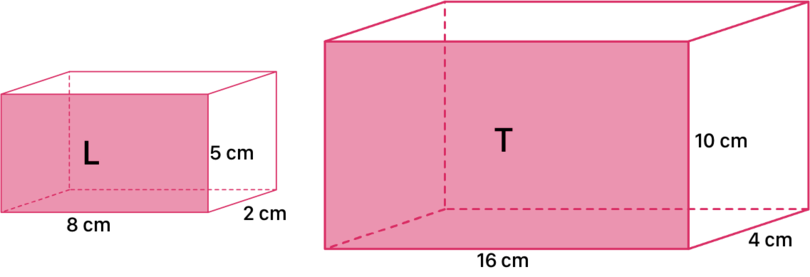
Summate the volumes of the two cuboids and compare the answers.
Utilize the value of in your comparing.
-
Step 1: Calculate the book of the given cuboid ( ).
\begin{align} \text{Volume of cuboid } Fifty& = fifty \times b \times h\\ &= 8 \times ii \times 5\\ &= \text{80 cm}^{3} \\ \end{marshal} -
Footstep ii: Calculate the volume of the new cuboid ( ).
\begin{marshal} \text{Volume of cuboid } T& = l \times b \times h\\ &= sixteen \times 4 \times 10\\ &= \text{640 cm}^{iii} \\ \end{marshal} -
Step iii: Compare the two answers.
We can write:
\begin{align} \text{Volume of new cuboid} & = viii \times \text{book of given cuboid} \\ & = two^{iii} \times \text{volume of given cuboid} \\ \finish{align}
This worked example shows another important relationship.
If an object is enlarged past a calibration factor , and then the volume of the new object will exist times greater than the book of the given object.
When we calculate volume, nosotros utilise iii dimensions to determine the book of an object. Therefore, if the calibration factor is , each of these three dimensions must be multiplied past to find the dimensions for the new object.
Volume of the new object = book of given object
We tin can summarise the effect of an enlargement using a scale factor of as follows:
- Length of the new line segment = length of given line segment
- Surface area of the new shape = surface area of given shape
- Book of the new object = volume of given object.
We can express each of these relationships as a fraction:
Nosotros tin also express these relationships as ratios:
\brainstorm{marshal} \text{length of given line segment } &: \text{length of new line segment}\\ = 1 & : k\\ \end{align} \begin{align} \text{area of given shape } & : \text{surface area of new shape}\\ = 1 & : k^{ii} \\ \stop{marshal} \begin{marshal} \text{volume of given object }& : \text{volume of new object}\\ = 1 & : yard^{3} \\ \end{marshal}
Exercise 9.5: Work with scale cistron, area, and volume
-
Two similar squares, and are given. Consider the diagrams and respond the questions that follow.

- What is the scale gene used to enlarge foursquare ?
\brainstorm{marshal} thousand & = \frac{\text{side of new square } F} {\text{side of given square } East} \\ & = \frac{20}{iv}\\ & =v \end{align}
The scale gene is 5.
- Calculate the areas of the two squares and write down a relationship between the two answers.
Area foursquare :
\begin{align} \text{Area}_{E} & = due south \times s \\ & = iv \times 4 \\ & = \text{16 cm}^{2} \\ \end{align}Area square :
\brainstorm{align} \text{Area}_{F} & = s \times s \\ & = 20 \times twenty \\ & = \text{400 cm}^{two} \\ \finish{align}Relationship between the ii areas:
Therefore, we can state that:
The relationship is: surface area square = surface area square
area square = area square
-
Consider the following rectangles. Rectangle is an enlargement of rectangle .
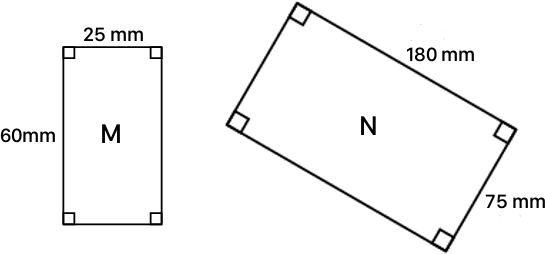
What is the human relationship between the areas of the two rectangles? (Show all your calculations.)
Find the scale factor get-go:
\begin{align} k & = \frac{\text{longer side of new shape } Northward} {\text{longer side of given shape } M} \\ & = \frac{180}{60} \\ & =3 \end{marshal}Surface area of given rectangle:
\brainstorm{align} \text{Area}_{\text{Grand}} & = l \times b \\ & = threescore \times 25 \\ & = \text{one,500 mm}^{2} \\ \end{marshal}Area of new rectangle:
\brainstorm{align} \text{Expanse}_{\text{Northward}} & = l \times b \\ & = 180 \times 75 \\ & = \text{13,500 mm}^{2} \\ \finish{align}Relationship between the two areas:
Therefore, we tin can state that:
The relationship is: Area rectangle = area rectangle
area rectangle = area rectangle
-
In the diagram beneath, is an enlargement of .

What is the human relationship between the areas of the two triangles? (Testify all your calculations.)
Find scale cistron get-go:
\begin{align} k & = \frac{PR}{DE} \\ & = \frac{22}{11} \\ & = 2 \finish{marshal}Expanse of given triangle ( ):
\brainstorm{align} \text{Expanse}_{\text{triangle}} & = \frac{1}{ii} \times b \times h \\ & = \frac{ane}{2} \times 11 \times v \\ & = \text{27.5 cm}^{2} \\ \cease{align}Area of new triangle ( ):
\begin{align} \text{Area}_{\text{triangle}} & = \frac{1}{ii} \times b \times h \\ & = \frac{1}{2} \times 22 \times 10 \\ & = \text{110 cm}^{two} \\ \end{align}Relationship betwixt the two areas:
\begin{align} \frac{\text{110 cm}^{2}} {\text{27.5 cm}^{two}} & = \frac{110 \times 10}{27.v \times 10} \\ & = \frac{one,100}{275} \\ & = iv\\ \end{align}Therefore, nosotros can country that:
The human relationship is: Area = area
Area = area
-
Objects and are 2 cuboids. Cuboid is an enlargement of cuboid .
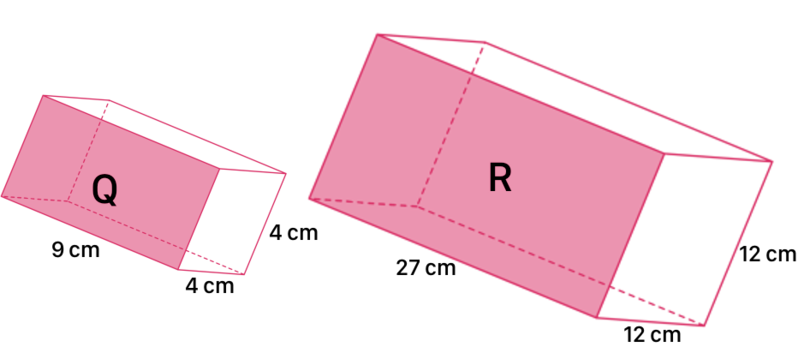
What is the relationship between the volumes of the 2 cuboids? Write the answer as a ratio in the class "Volume cuboid : Volume cuboid ".
Find the scale factor showtime:
\brainstorm{marshal} k & = \frac{\text{longest side cuboid } R}{\text{longest side cuboid } Q} \\ & = \frac{27}{ix}\\ & = 3 \end{align}Book of cuboid :
\begin{align} \text{Volume of cuboid } Q& = l \times b \times h\\ &= 4 \times 4 \times nine\\ &= \text{144 cm}^{three} \\ \cease{align}Volume of cuboid :
\begin{align} \text{Volume of cuboid } R& = fifty \times b \times h\\ &= 12 \times 12 \times 27\\ &= \text{3,888 cm}^{3} \\ \end{align}Ratio:
\begin{marshal} \text{Volume cuboid } Q & : \text{Volume cuboid }R\\ = 144& : iii,888\\ = 1& : 27\\ = one & : iii^{3}\\ \end{align} -
Objects and shown beneath are cubes. Cube is an enlargement of cube , where .
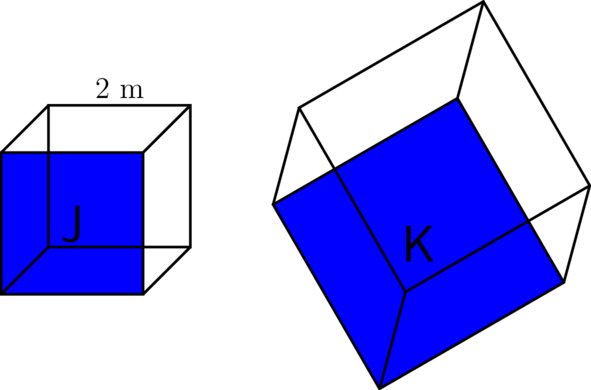
- Summate the length of one side of cube .
\begin{align} \text{Length of side cube } 1000 & = k \times \text{length of side cube } J\\ &= 4 \times ii\\ &= \text{viii yard}\\ \end{align}
- Calculate the area of ane confront of cube .
The face of a cube is a square.
\brainstorm{align} \text{Surface area of face cube } G& = g^{2} \times \text{surface area of face cube } J\\ &= four^{2} \times southward \times s\\ &= sixteen \times ii \times 2\\ &= \text{64 m}^{two} \\ \end{align}- Calculate the volume of cube .
\begin{marshal} \text{Volume of cube }Chiliad & = grand^{3} \times \text{volume of cube } J\\ &= 4^{3} \times south \times s \times s\\ &= 64 \times ii \times two \times ii \\ &= \text{512 m}^{2} \\ \stop{marshal}
9.3 Applied applications
Using like shapes and scale factors tin be very helpful in solving problems in our daily lives. In this department you will accept the opportunity to use all the knowledge that you take gained in this chapter.
Worked example ix.5: Using the scale factor to solve a trouble
Oladapo wants to notice out the height of a lamp post. Oladapo is 1.v thou tall. The length of Oladapo'due south shadow changes throughout the day.
Oladapo stands in the shadow of the lamp postal service, then that his shadow and the lamp post'southward shadow are in a directly line. The shadows of the lamp post and of Oladapo course triangles, as shown in the diagram below.
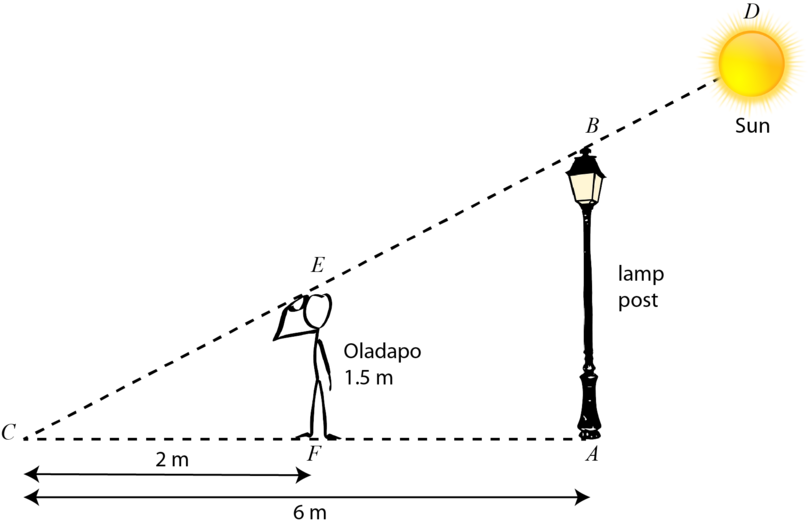
Oladapo'due south shadow is 2 m long and the the shadow of the lamp post is half-dozen chiliad long.
Depict a diagram showing the triangle formed by Oladapo and his shadow, and a carve up diagram showing the lamp mail and its shadow. Use your diagrams and find the scale factor of the two trianges to help Oladapo piece of work out the height of the lamp post.
-
Step one: Draw two divide triangles and fill in all the given information.

-
Step ii: Discover the scale gene.
is an enlargement of .
\begin{align} g & = \frac {CA}{CF} \\ & = \frac{6}{2} \\ &= 3\\ \end{align} -
Step iii: Calculate the height of the lamp post.
The lamp post is represented past in the diagram.
We accept Oladapo's meridian, which is EF in the diagram, and we now take the scale cistron, so we tin can calculate the meridian of the lamp post.
\begin{align} BA& = k \times EF\\ &= 3 \times \text{i.5 1000}\\ &= \text{four.5 thou}\\ \cease{marshal} -
Step iv: Give your respond using a full sentence, and include the correct unit of measurement.
The height of the lamp postal service is 4.v m.
In real-life questions, every bit in the example above, nosotros presume that vertical objects like lamp posts and homo beings are perpendicular to the ground. We too presume that the ground is perfectly horizontal.
Practice 9.6: Utilise similar shapes and the scale factor to solve bug
-
Ndidi wants to detect out the height of a tree. She is ane.vi m tall. The length of Ndidi's shadow changes throughout the day.
At a certain time, Ndidi'southward shadow is 3 m long and the shadow of the tree is 6 one thousand long.
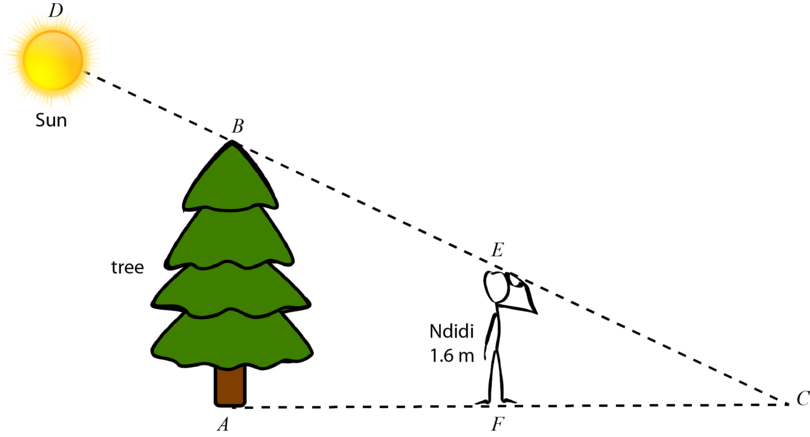
Help Ndidi to work out the summit of the tree.
Redraw the diagram with the 2 triangles separate from each other.
The ii triangles with all the given information are shown below.

is an enlargement of .
\begin{align} k & = \frac {AC}{FC} \\ & = \frac{half-dozen}{3} \\ &= 2\\ \finish{marshal}The tree is represented by on the diagram.
\brainstorm{align} BA& = 1000 \times EF\\ &= 2 \times \text{i.6 m}\\ &= \text{3.two m}\\ \terminate{align}The tree is three.2 yard loftier.
-
Consummate the tabular array below.
length of given side length of new side i.5 30 mm vii 371 cm 28.75 grand 287.v m length of given side length of new side 1.5 30 mm 1.5 30 = 45 mm 7 53 cm vii 53 = 371 cm ten 28.75 m 10 28.75 = 287.v m -
is a trapezium with measurements (in cm) as shown in the diagram below.
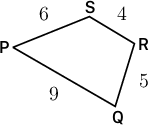
Summate the perimeter of the enlargement of if a scale cistron of 2.25 is used.
\begin{marshal} \text{Perimeter}_{\text{PQRS}}& = \text{sum of sides}\\ & = 9 + 5 + 4 + 6\\ &= \text{24 cm}\\ \terminate{align} \begin{align} \text{Perimeter}_{\text{new shape}}& = k \times \text{perimeter of given shape} \\ & = 2.25 \times \text{24 cm}\\ &= \text{54 cm}\\ \finish{align}
OR
Calculate the length of each new side starting time.
If you exercise not have a diagram of the new shape with new labels for the sides, yous can use the prime symbol ( ) to show that you are working with the sides of the new shape. And then is the side of the new shape that corresponds with in the given shape.
\begin{align} \text{Perimeter of new shape} & = 20.25 + xi.25 + 9 + 13.5\\ &= \text{54 cm} \\ \end{align} -
Complete the table below.
expanse of given shape area of new shape iv vi area of given shape surface area of new shape 4 = 6 = ix = -
Faruq is designing a pattern to decorate a wall outside a store. The blueprint consists of two equal squares and a rectangle in the middle.
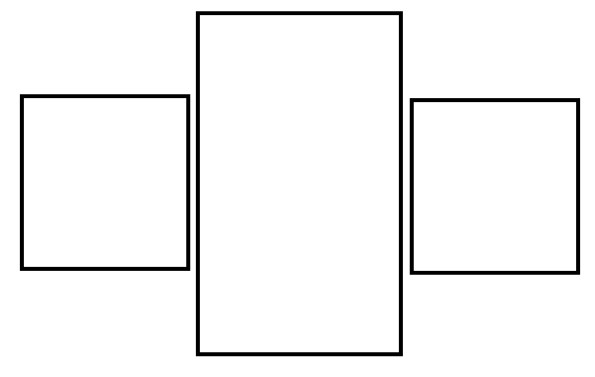
The area of one of the squares is and the area of the rectangle is .
Summate the total area of the three shapes if the pattern is enlarged past a scale gene of 5.
Summate total area of given shapes:
\begin{align} \text{Total area} & = 9 + 21 + ix \\ &= \text{39 cm}^{two} \\ \end{align}Summate area of new shapes:
\begin{align} \text{Area of new shapes} &= 1000^{two} \times \text{area of given shapes}\\ &= 5^{2} \times 39 \\ &= 25 \times 39 \\ &= \text{975 cm}^{2} \\ \end{marshal} -
Consummate the table below.
book of given object volume of new object 2 three = = volume of given object volume of new object 2 = 3 = 5 = -
Chike is working with the diagram of a cuboid that is given below.
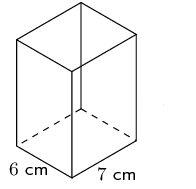
Unfortunately the diagram does non testify the height of the cuboid. The only information that Chike has is this:
If the cuboid is enlarged by a factor of two, the volume of the cuboid will exist .
Help Chike to calculate the height of the cuboid in the diagram.
Chike tin employ the human relationship of the two volumes: Volume of new cuboid = volume of given cuboid
This is an equation. First, Chike must calculate the volume of the given cuboid, and Chike tin can solve this equation to exercise that.
\begin{align} k^{three} \times \text{volume of given cuboid} & = \text{volume of new cuboid}\\ 2^{3} \times \text{volume of given cuboid} & = 3,360 \\ eight \times \text{volume of given cuboid} &= 3,360\\ \therefore \text{volume of given cuboid} & = 3,360 \div 8 \\ & = \text{420 cm}^{3} \\ \finish{align}Now that Chike has the volume of the given cuboid, , he can solve the equation for volume to find the height, which is the unknown.
\brainstorm{align} fifty \times b \times h &= \text{volume}\\ seven \times half-dozen \times h &= 420\\ 42 \times h &= 420\\ h &= 420 \div 42\\ \therefore h &= \text{x cm} \\ \end{marshal}The height of the cuboid in the diagram is 10 cm.
-
The cube shown below has a book of .
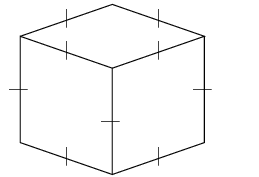
Summate the dimensions of an enlarged cube that has a book of .
Notice the value of kickoff:
\begin{align} k^{iii} & = \frac{\text{volume of new cube}}{\text{book of given cube}} \\ &= \frac {one,728}{27} \\ &= 64\\ \end{align}From y'all demand to find the value of . You can find the prime factors of 64:
In that location are half dozen factors hither, and yous need to have 3 factors:
, and so
The given cube was enlarged by a scale gene of 4.
It is given that the book of the given cube = .
The formula for the volume of a cube is .
Then you besides need to have three factors of 27. The prime factors of 27 are .
Therefore, each side of the given cube = .
\begin{marshal} \text{Side of new cube} & = thou \times \text{side of given cube} \\ &= 4 \times three \\ &= \text{12 cm} \\ \end{align}The dimensions of the enlarged cube are .
9.iv Summary
- In Mathematics, 2 shapes are similar if:
- their matching sides are in proportion, and
- their matching angles are equal.
- The sides of two shapes are in proportion if all of the sides of the given shape accept been multiplied past the same number to become the sides of the new shape. This number is called the calibration cistron.
- Nosotros can use the variable to represent the calibration factor.
- An enlargement of a diagram, shape or object is a copy of the original in which everything is made larger, keeping the same proportions.
- Nosotros can summarise the effect of an enlargement using a scale gene of as follows:
- Length of the new line segment = length of given line segment
- Area of the new shape = area of given shape
- Book of the new object = volume of given object
-
We can express each of these relationships as a fraction:
- We can likewise express these relationships as ratios:
\begin{marshal} \text{length of given line segment } &: \text{length of new line segment}\\ = one &: one thousand\\ \end{align} \begin{marshal} \text{area of given shape }& : \text{area of new shape}\\ = 1 & : k^{ii} \\ \stop{align} \begin{align} \text{book of given object }& : \text{volume of new object}\\ = 1 & : grand^{3} \\ \end{align}

How Are The Shapes Alike,
Source: https://ng.siyavula.com/read/maths/jss3/similar-shapes/09-similar-shapes
Posted by: ocasiogrou1983.blogspot.com
0 Response to "How Are The Shapes Alike"
Post a Comment